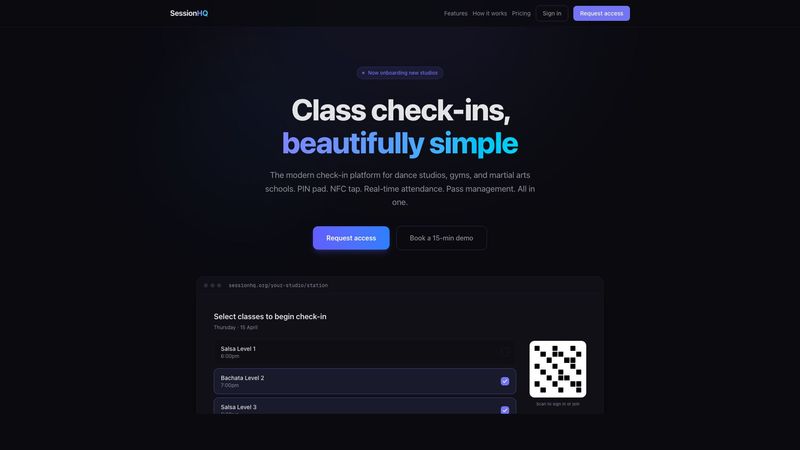
Nine weeks and 283 commits after the first scaffold on 12 February, SessionHQ is running the front desk at Havana on the Hastings in Port Macquarie: a member walks in, types a PIN, taps a wristband on the tablet or scans a QR code with their phone, one class is deducted from their pass, and the admin’s live feed updates. It is Zack Design’s own product, built for many studios on one database from the first migration, and at launch it carries 888 unit tests and 107 browser tests (written with Playwright, which drives a real browser) across 22 spec files.
This post covers how the studio’s identity is carried inside each user’s sign-in token so that Postgres enforces the separation between studios without trusting application code, the nightly job that renews passes and charges cards on file, how tap-to-check-in and card payments work from a plain web page, and four bugs that only showed up on a real tablet at a real front desk: Android Chrome refusing to read Supabase timestamps, a sign-in cookie Android could not read, a Square library returning numbers JSON cannot encode, and a Workers promise that was cancelled before it ran.
What SessionHQ does
Small studios run on spreadsheets, paper sign-in sheets and a payments app that does not know what a class pack is. SessionHQ replaces that with three surfaces from one codebase: a kiosk (/station/[eventId]) for the tablet at the door, a member web app that installs to the phone’s home screen (/member) for balances and history, and an admin (/admin/checkins, /admin/members, /admin/catalog, /admin/reports) for the people running the night.
- Check in fast. PIN entry, a wristband tap on the tablet, or a QR scan that opens
/checkin/[eventId]on the member’s own phone. No app install. - Passes just work. Class packs, casual rates and unlimited passes;
apply_pass_to_checkindeducts one class at check-in time, and the nightlypass-renewalsjob charges the saved card when a pack runs out. - Payments where the student is. Square’s Web Payments SDK turns the card details into a one-time token inside the browser; our API only ever sees that token (
source_id) or a stored card reference (square_card_id), never the card number. - Admins see the truth. Tonight’s attendance, revenue, unpaid check-ins and pass status reports.
Each studio’s identity travels inside the sign-in token
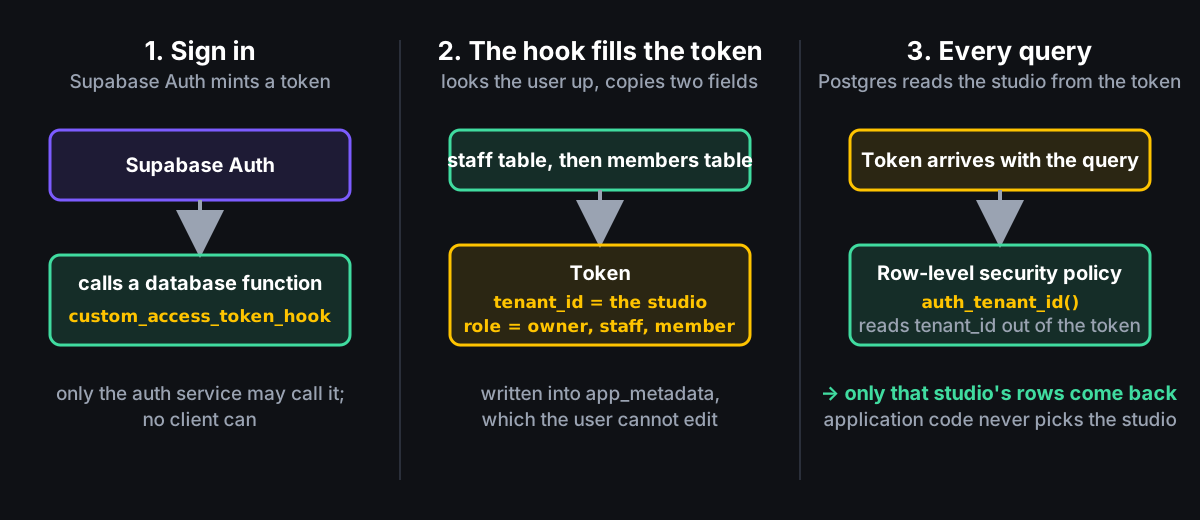
Every table a studio owns has row-level security enabled, which means Postgres itself decides which rows each query may see. Every one of those policies calls the same two functions from supabase/migrations/20260101000000_initial_schema.sql:
create or replace function auth_tenant_id() returns uuid as $$
  select (auth.jwt()->'app_metadata'->>'tenant_id')::uuid;
$$ language sql stable security definer;

create or replace function auth_tenant_role() returns text as $$
  select auth.jwt()->'app_metadata'->>'role';
$$ language sql stable security definer;
They read the signed sign-in token (a JWT) that arrives with every query. The studio id in that token is written by custom_access_token_hook, a Postgres function that Supabase Auth calls while creating the token. It looks the user up in tenant_users (staff, admins, owners) and then in members, and copies tenant_id and role into the token’s app_metadata section, which the user cannot edit. Permission to run the hook is granted to supabase_auth_admin and revoked from authenticated, anon and public, so nothing a client can call touches it. A studio cannot query another studio’s rows because the database never sees a studio id that did not come from the token. The service-role key bypasses row-level security; the API uses it only after its own check that the caller belongs to the studio.
One nightly job does the money work
The app deploys to Cloudflare Workers through OpenNext (the adapter that runs Next.js on Workers), with custom-worker.ts wrapping the generated handler so the same Worker also owns a scheduled() entry point. A single scheduled trigger at 03:00 UTC (0 3 * * *) runs the whole nightly pipeline. Three jobs run one after another, because each reads the state the previous one wrote: pass lifecycle, then pass renewals, then lifecycle emails. Four more run alongside them at the same time: database backup, backup pruning, the retention sweep and email retry.
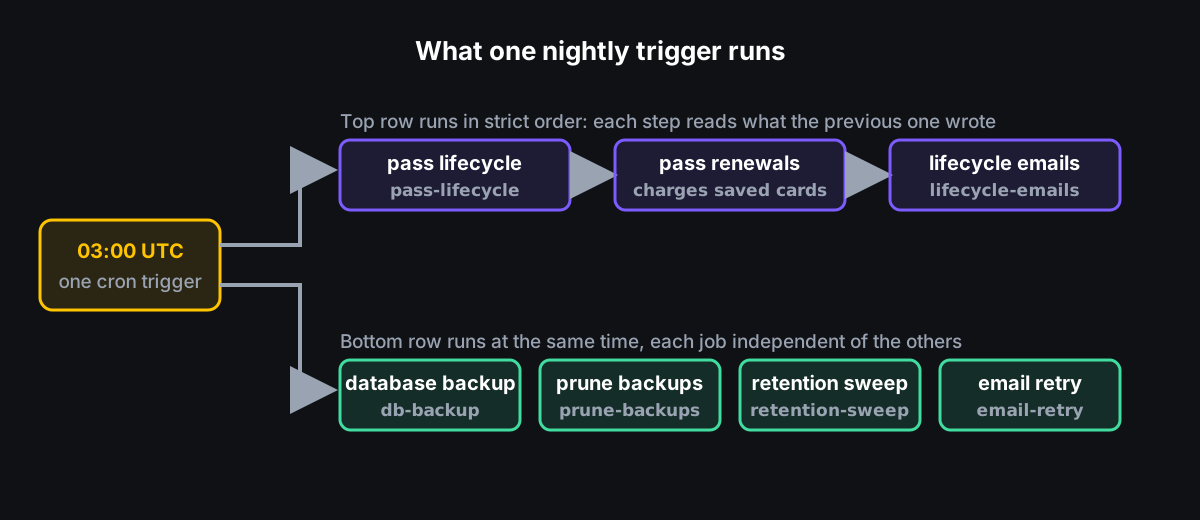
Backups go to R2 (Cloudflare’s file storage) and are pruned to 30 daily copies plus 12 monthly. The retention sweep calls sweep_inactive_members, which anonymises members with no check-ins in three years.
Each job runs inside runJob(), which logs a one-line result and reports any failure to Sentry, the error-tracking service, tagged with cron_job. At launch that reporter was a hand-written POST to Sentry’s old /api/{id}/store/ endpoint. It was later found to send a placeholder stack frame (filename: "cron") instead of the real stack trace, so a failure in the nightly money pipeline could not be traced to a line of code; it has since been replaced with withSentry from @sentry/cloudflare, wrapping only the scheduled entry point, because @sentry/nextjs already handles the request path.
Tap-to-check-in and card payments from a web page
The kiosk is a web page, so reading a wristband uses Web NFC, the browser API for near-field communication tags. src/lib/nfc.ts is 39 lines: check that "NDEFReader" in window, call ndef.scan({ signal }), and hand the serialNumber from the reading event to the check-in flow. The tag’s serial number is all the check-in flow matches on; nothing is ever written to the tag. Where NDEFReader does not exist, the reader is never started and PIN entry is the path.
Square’s per-studio access tokens are stored in Supabase Vault, the encrypted secrets store, by store_square_tokens(). The first version inserted straight into the vault.secrets table; the correct call is vault.create_secret(), and because Vault has no update function, rotating a token is a delete followed by a create.
Four bugs from the front desk
| What the user saw | What was actually happening | What fixed it |
|---|---|---|
| The check-in feed showed “NaN” for every member’s age on the tablet, and correct ages on every laptop (13 February). | Supabase returns timestamps like 2026-02-13 05:52:06.136236+00: a space instead of a T, six decimal places, and a short +00 zone. Android Chrome’s Date parser rejected the zone and then the six decimals. postgres-date was tried and broke the browser bundle because it is CommonJS-only. |
src/lib/time.ts parses the string with one regular expression, trims the fraction to three digits, and builds the instant with Date.UTC(). src/lib/time.test.ts covers each variant. |
Signing in from the emailed link failed with missing_code. |
The callback route expected a code parameter (the PKCE flow); the browser client was on the default implicit flow and put the tokens in the URL fragment instead. On Android, a second problem: the sign-in cookie was unreadable after a reload. |
One line in src/lib/supabase-browser.ts, { auth: { flowType: 'pkce' } }, then httpOnly: false set explicitly on the cookie. |
| Saved cards were invisible on the profile page, and replacing a card failed after Square had already created the new one. | Square SDK v44 returns expMonth and expYear as BigInt, a number type JSON.stringify refuses to encode, so both the GET and the PUT handlers crashed while encoding a successful result. |
The route converts those two fields to ordinary numbers before responding, and a regression test pins it. |
A new member was created and the welcome email never arrived; email_log had zero rows (launch day). |
On Workers, a promise nobody waits for is cancelled the moment the response is sent. The call to Resend (the email service) and its log writes were started and left, so they never completed. | Every such send goes through a queueEmail() helper that wraps it in ctx.waitUntil(), which keeps the Worker alive until the promise settles. |
The last one is the same primitive the Rollbar client on this blog leans on, and it is easy to forget from inside a Next.js route.
What else is in from day one
-
Rate limits on the write endpoints, counted in memory per Worker instance:
Endpoint Per IP address Per user POST /api/checkins120 per minute 30 per minute POST /api/payments/create20 per minute 10 per minute - Idempotency. A request that carries an
Idempotency-Keyheader is remembered for 24 hours inidempotency_keys, keyed by the header, the studio and the endpoint, so a retried request cannot charge or check in twice. - GDPR. Consent timestamps on
members,POST /api/admin/members/[id]/anonymizebehind a typed confirmation,GET /api/admin/members/[id]/export, and an audit trail on check-ins, passes, payments and member updates. - Personal data scrubbing in Sentry’s
beforeSendhook: medical notes, PINs and payment tokens never leave the Worker. - A design system of 21 base components in
src/components/ui/, on Tailwind 4 with Next.js 16 and React 19. Not shadcn; we wanted to own it. - 48 migrations, applied in filename order, as the only schema definition.
Why we built it
We have spent more than 20 years building software for other people. SessionHQ is ours: the roadmap, the pricing, the customer relationship, and the bug reports. It is also a proof point that a small team can ship software that serves many studios from one system with real isolation, real payments and real tests, without an enterprise price tag.
Founding partner: Havana on the Hastings
SessionHQ launched with a customer. Havana on the Hastings is Port Macquarie’s Latin dance community: Cuban salsa, bachata, urban kiz and rueda, the dance that brought founders Mike and Kellie together. They were already running on the pass model SessionHQ is built around, so every feature above was tested at their front desk on a class night, by the people who would use it, before it shipped. The founding-partner agreement is signed and sits in the repo.
If you are in Port Macquarie and want to dance, drop in. Absolute beginners are welcome every week.
What’s next
SessionHQ is onboarding new studios now. If you run a dance studio, gym, yoga or pilates studio, martial arts school, or climbing gym — or if you know someone who does — we would love to talk.
- Visit sessionhq.org to see the product.
- Request access on the site, or book a 15-minute demo via
[email protected].
This is the start of something we are going to spend years building on. Thanks for being here for the beginning.