
Zack Design has published durable-sync, the sync layer from Rampset extracted into a library, after a week-long incident in which a finished workout was silently destroyed in production. The cause was one line: the client drained its outbox on res.ok, and behind Cloudflare Access an expired session redirects to a same-origin login page that fetch follows and reports as a 200. The write was deleted from the phone and had never reached the server. The package is an append-only op log inside a Durable Object’s SQLite plus a durable outbox on the client: 983 lines of TypeScript, 26,969 bytes of JavaScript in dist/, no runtime dependencies, no Postgres, no long-running container, no WebSocket. Seventeen commits and five releases went out on 16 July 2026, most of them fixing something the previous one had shipped. MIT licensed, on npm.
This post walks through why a Durable Object already is the ordering point that sync engines run Postgres to get, the four silent data-loss bugs the code encodes (the res.ok one, a cursor pointing past a reset log, a pull landing mid-workout, and one user’s writes filed under another’s journal), a fifth found while writing tests for the SQL path that had never executed, the comparison table I got wrong in my own favour, and the 71 unit and 16 workerd tests that now stand in front of all of it.
Docs & live demo → isaacrowntree.com/durable-sync · Source → github.com/isaacrowntree/durable-sync (MIT) · npm → durable-sync
The ordering point is already there
The credible offline-first engines in 2026, Zero, Electric, PowerSync, all want Postgres and a service in front of it. On an all-Cloudflare stack that is a second backend, run forever, to get one property: a single place that decides the order of one user’s writes. A Durable Object is that place by construction. It is single-threaded, it has its own SQLite, and env.JOURNAL.idFromName(userKey) gives every user their own. The header comment in src/server/journal.ts is the whole design:
The Durable Object is the single-threaded consistency point that orders one user’s ops; this module is the pure logic, so it’s testable without a Workers runtime. Ops are opaque:
{ opId, kind, payload }. The log never interprets a payload, which is what keeps it a primitive rather than a database.
The schema is three tables:
CREATE TABLE IF NOT EXISTS ops (
  seq INTEGER PRIMARY KEY AUTOINCREMENT,
  op_id TEXT NOT NULL UNIQUE,
  kind TEXT NOT NULL,
  payload TEXT NOT NULL,
  ts INTEGER NOT NULL
);
CREATE TABLE IF NOT EXISTS meta (k TEXT PRIMARY KEY, v TEXT NOT NULL);
CREATE TABLE IF NOT EXISTS snapshot (id INTEGER PRIMARY KEY CHECK (id = 1), seq INTEGER NOT NULL, blob TEXT NOT NULL);
op_id is the idempotency key, so a client that is not sure a push landed retries it and the log ignores the duplicate. Because the DO is single-threaded the check-then-insert has no race. There is no conflict resolution on purpose: if writes are events (“this workout happened”) rather than edits, two devices appending do not conflict, they interleave. HTTP rather than WebSocket, because gyms are Faraday cages and a socket that cannot connect is not a feature. The server is a class you extend and a route you write; what you do not forward, a client cannot reach:
// examples/notes/worker.js
import { SyncJournal } from "durable-sync/server";
export class Journal extends SyncJournal {}

const journal = env.JOURNAL.get(env.JOURNAL.idFromName("demo"));
if (req.method === "POST") {
  const { ops } = await req.json();
  return Response.json(await journal.push(ops));
}
reset() exists on the DO. Nothing routes to it. That is the access model, and it is why 0.3.0 replaced the DO’s internal fetch router with native RPC methods: the router was a layer I did not write, sitting between the Worker and the log, special-casing DELETE.
Bug one: a successful status code is not evidence
The first version of the client in Rampset did what every example does: POST the outbox, and on res.ok delete the queued rows. Cloudflare Access sits in front of the Worker. When the Access session expired, the request was redirected to the login page on the same origin, fetch followed the redirect, and the response was a 200 with an HTML body. The outbox was drained against it. The fix in src/client/transport.ts is a type guard on the body, and the comment above it is the incident report:
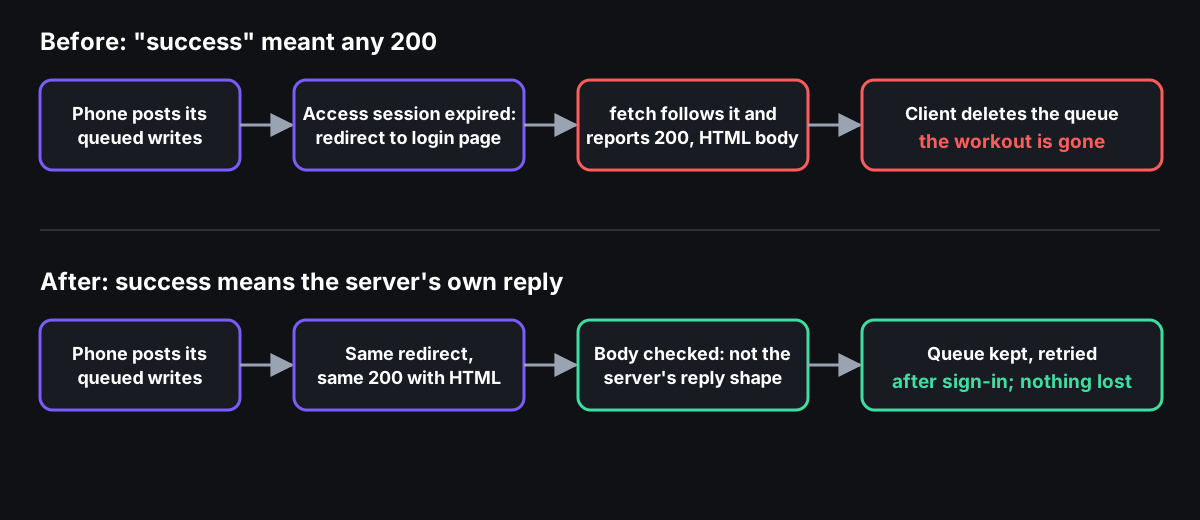
/** Did this response really come from the journal?
 *
 * Behind an auth proxy (Cloudflare Access, and others), an expired session
 * redirects to a same-origin login page — which fetch FOLLOWS, and reports as
 * a 200. `res.ok` is therefore not evidence of anything. The outbox may hold
 * the only copy of a write, so it may only be drained against a reply the
 * journal demonstrably wrote. */
function isJournalReply<T extends { seq?: unknown }>(body: T | null): body is T & { seq: number } {
  return typeof body?.seq === "number";
}
The client also sends x-requested-with: XMLHttpRequest, which makes a well-behaved proxy answer an expired session with a 401 instead of a login page. That is belt and braces; the guard is what protects the outbox.
Bug two: a cursor only means something against the log that issued it
Each client stores the highest seq it has applied and pulls seq > cursor. During the incident I reset the journal. Every client was then holding a cursor from a log that no longer existed, usually pointing past the rebuilt one, so seq > cursor matched nothing, and every client silently never synced again. Now the meta table carries an epoch, a crypto.randomUUID() stamped on first use and replaced by reset(), and every pull reply carries it:
const epoch = body.epoch;
if (epoch && epoch !== current.epoch) {
  // The replay a reset forces is the most expensive pull there is, so
  // it's the one that most wants a fold.
  body = await fetchPull(0, !!snapshot);
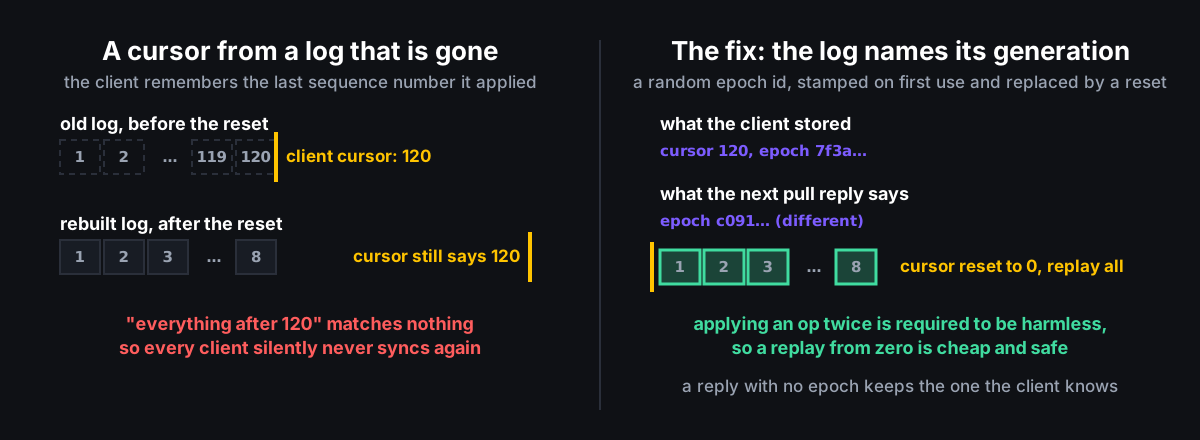
apply is required to be idempotent, so a replay from zero is cheap and safe. There is a smaller bug hiding next to this one: when a reply omits the epoch the client must keep the one it knows, not write undefined, or the next reply that has one looks like a new generation and triggers a needless full replay. Rampset guarded that. The extraction regressed it, and the second commit of the day put it back.
Bug three: pulling is not always safe
Pushing never disturbs the device that pushes. Pulling applies someone else’s op to local state, and in Rampset a remote op landing mid-workout rewrote the working weight the finish logic reads back, and turned a logged 5×5 into a 3×5. The engine therefore has two gates and they are asymmetric:
async function run(): Promise<number> {
  const pushed = await transport.push();
  if (!(await canPull())) {
    // A clean push is as synced as we can honestly claim right now.
    record(pushed.ok ? { lastOkAt: now() } : { ...snapshot, lastError: UNREACHABLE });
    return 0;
  }
  const pulled = await transport.pull();
Returning false from canPull() pushes and tries again later. Eventual consistency makes the wait free.
Bug four: the gate has to be the only door
The journal is addressed by the server-side identity; the ops carry whatever lifter the client had selected. With canWrite() on the engine but createTransport exported, a caller could reach past the gate and push directly, which is exactly how Rampset posted one user’s workouts to another’s journal, got a valid ack, and drained the outbox against it. In an append-only log that is permanent. The fix is not a check, it is a missing export. The top of src/client/index.ts:
// createTransport is deliberately NOT exported. Reaching past createSync to
// the transport bypasses canWrite() — which is exactly how the app this came
// from posted one user's workouts to another's journal and drained the outbox
// against the ack. The gate is the only door.
sync.now({ force }) skips the ten-second throttle and never the gate.
Bug five arrived while writing tests for bug one
0.1.0 shipped with 33 tests, every one of them against MemoryOpStore. SqlOpStore, the class every production journal actually runs, had no tests, so no constraint or upsert in it had ever been executed by the suite. Writing them (against real SQLite through node:sqlite) surfaced a bug in the reply format. The journal refuses an op with a blank opId or kind and reported that in accepted, but the client drained the whole outbox against any well-formed reply and never looked. A count cannot carry the distinction: accepted: 1 of two ops means one stored and one refused, or one stored and one duplicate, and those need opposite handling. 0.2.0 changed push to return stored: string[], the ids the log now holds, and the client drains exactly those:
const stored = Array.isArray(reply.stored) ? new Set(reply.stored as unknown[]) : null;
const drain = stored ? rows.filter((r) => stored.has(r.opId)) : rows;
await outbox.remove(drain.map((r) => r.id));
A Worker older than the client sends no stored, and the client keeps the old behaviour rather than stall a rollout where the PWA leads the Worker. The same bug as trusting res.ok, one layer in.
Proving the SQL runs where it ships
The unit suite proves the logic and that the SQL parses. It cannot prove the SQL behaves the same on the DO’s own SQLite, which is the one place a divergence would only ever surface at runtime, in production. So there is an opt-in integration suite that boots workerd through @cloudflare/vitest-pool-workers and drives a real SyncJournal: push and the stored[] ack, pull, snapshot upsert, reset dropping the snapshot, the stale-epoch refusal.
npx vitest run
 Test Files  4 passed (4)
      Tests  71 passed (71)
   Duration  174ms

npx vitest run --config vitest.integration.config.ts
 Test Files  1 passed (1)
      Tests  16 passed (16)
   Duration  1.41s
It is npm run test:integration, not npm test, and its CI workflow is workflow_dispatch only, because it is an order of magnitude slower and never needs to block a publish. The integration worker imports src/, not dist/, so a regression is caught before a publish.
What I got wrong about the competition
0.1.2 has no code changes. The docs site carries a comparison against Zero, Electric, PowerSync and Cloudflare’s partysync, and when I fact-checked it against their primary docs three of the four rival rows were wrong, every error in my favour. partysync is delta sync with an IndexedDB read cache, so the gap is a write queue and nothing else; Zero rejects writes while disconnected, which is an explicit non-goal rather than a shortcoming; PowerSync’s “conflict resolution: yes” had been overstated. The commit is titled “Correct the rival claims — every error flattered us”. The table now says, in its own caveat, that it was written by someone with an obvious interest.
What you write
import { createSync, localStorageCursor } from "durable-sync/client";

export const sync = createSync({
  endpoint: "/api/sync",
  outbox: dexieOutbox(db.outbox),          // durable — it may hold the only copy
  cursor: localStorageCursor("myapp.cursor"),
  async apply(op) { /* idempotent: an op can arrive twice */ },
  canPull: async () => !(await somethingInProgress()),
});
The outbox must be IndexedDB, not memory: until a push is acknowledged it may be the only copy of the write in existence, and iOS kills backgrounded PWAs. start() syncs on visibilitychange, focus, online and pageshow (a tab restored from the bfcache does not fire visibilitychange), with a minIntervalMs of 10 s to collapse the burst a single foregrounding produces, and a 5-minute poll as a safety net that iOS will freeze anyway. There is a runnable example in the repo, a Worker plus a browser client with a real IndexedDB outbox, and a live demo whose Offline button flips window.fetch so you can watch ops queue with no sequence number and then drain.
When to use something else
A pull returns everything after the cursor in one response, fine for thousands of ops and not for millions. There is no live push; the other device converges on its next foreground. There is no auth: the DO key is your isolation boundary. One createSync per identity, memoised, because the throttle lives in the closure. And nothing runs while the app is closed, because Safari has no Background Sync and pretending otherwise would be a lie. If two people need to edit the same record and have it merge, you want a CRDT, Yjs or Automerge. If you already run Postgres, Zero, Electric and PowerSync are better engineered for the general case. The slice where durable-sync is the right answer is narrow: all-Cloudflare, writes that are events, and an app that has to keep working on a train.
What the extraction taught me
The op log is a hundred lines and the outbox is an interface; anyone could write those in an afternoon. Every non-obvious line in the package is a bug that shipped, and each of them failed silently with lastOkAt set and the status row green. The one that cost a workout was a redirect fetch followed on my behalf. The one that cost every client’s sync was a reset() I ran myself. The fifth was found only because the class that runs in production finally had a test, which is the sentence I would put at the top of the README if I were starting again. The code is small; the scar tissue is the product.