
Zack Design has published Rampset, an open-source strength-training app that works offline first, built as a progressive web app (a website you install like an app), and it replaced the app I had logged my lifting in for years. A sign-in bug locked me out of that app; support’s resolution, after a morning of screenshots, was to cancel my grandfathered subscription, and the only way back was a new plan at a much higher price. My history exported to CSV, 1,270 workouts, and that file became Rampset’s first import. It runs three training styles on one engine, works in a gym with zero signal, syncs between devices through a Durable Object per user (Cloudflare’s single-instance server object with its own SQLite database), and saves a snapshot of every workout to R2, Cloudflare’s file storage. MIT licensed, built to self-host on your own Cloudflare account.
This post covers the engine (linear progression; the stall protocol that steps a lift from five sets of five down to three sets of five and then one set of five; weight reductions scaled to how long you were away; Madcow’s ramp fractions), the offline mechanics (a three-second network timeout in the service worker, a rest timer based on a saved start time rather than a countdown, a bell synthesised from two sine tones), and the production incident on 14 and 15 July in which a finished workout was erased, which produced four fixes that later became the durable-sync library.
Site and guide: isaacrowntree.github.io/rampset · Source: github.com/isaacrowntree/rampset (MIT)
Three ways to train, one engine
The constraint that shaped the architecture was not me. My wife trains too, and her program looks nothing like mine. So the Program row carries a mode, and finishWorkout branches on it:
export type ProgramMode = "progression" | "routine" | "madcow";
-
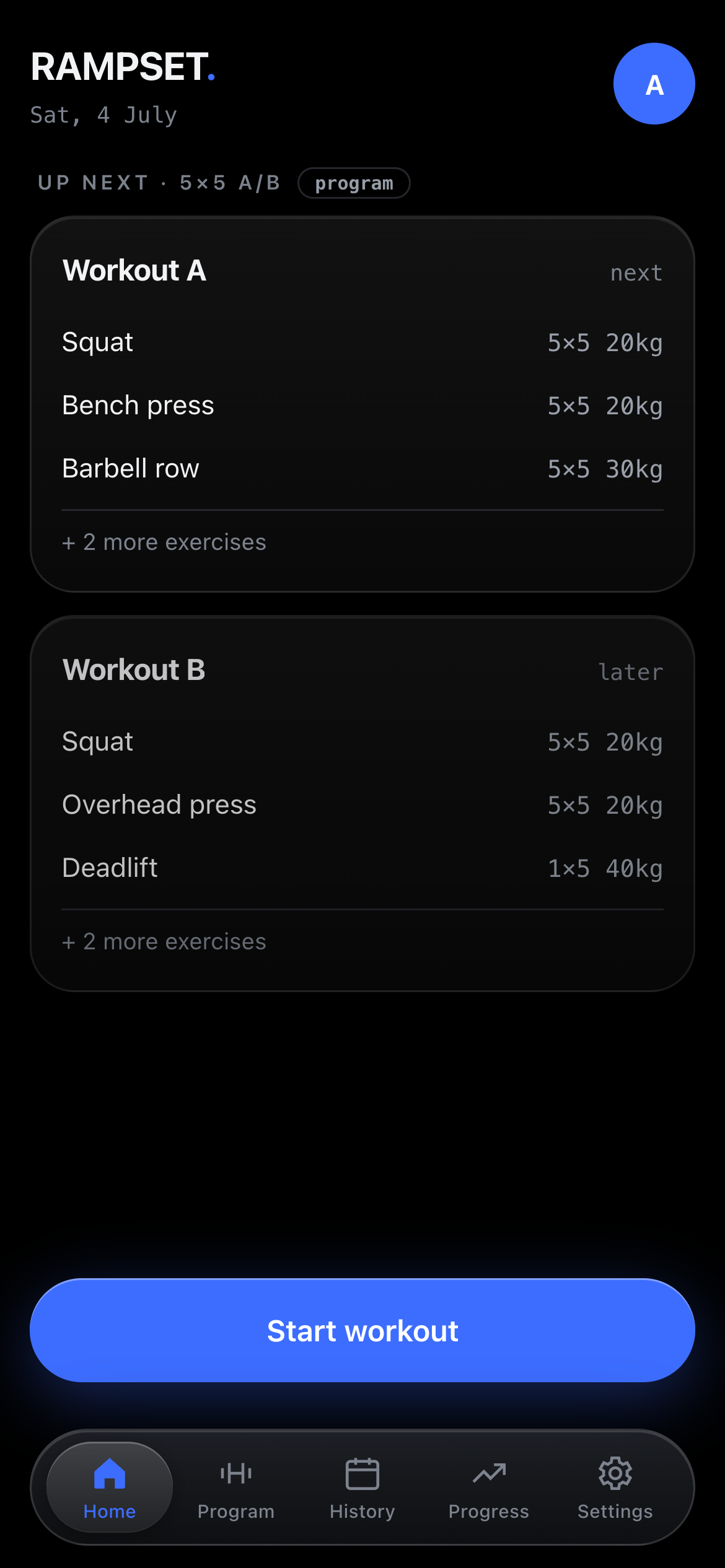
Program mode is StrongLifts-style training: five sets of five, alternating two workouts (A and B), with the family of variants (Plus, Lite, Mini, Ultra, Ultra Max). The engine in
src/lib/progression.tsis a pure function. A successful workout addsincrementKgto the lift: 2.5 kg on the main lifts, 5 kg on the deadlift, nothing on the assistance lifts. Three failures in a row subtractdeloadPct, 10%, rounded to the nearest 2.5 kg. The stall protocol lives on the program slot asdeloadCount: after the first deload the lift stays at five sets of five, after the second it drops to three sets of five, after the third to one set of five. Warm-up sets ramp up to the working weight like this:Warm-up set Fraction of the working weight Reps 1 one half 5 2 two thirds 5 3 five sixths 3 4 eleven twelfths 2 Plate math works out the plates for one side of the bar, largest first, from the 20, 15, 10, 5, 2.5 and 1.25 kg plates, and returns
nullrather than lie when a weight cannot be loaded exactly. -
Madcow mode is five sets of five ramped up over the week.
src/lib/madcow.tsencodes the three days directly:Day What it does Heavy four sets climbing through 50%, 62.5%, 75% and 87.5% of the top weight, then a top set of five Light the same ramp, stopping at 75% Intensity climbs to a personal-record set of three reps at the top weight plus one increment, then a back-off set of eight at 75% If the personal-record set succeeds, next week’s top weight moves up.
-
Routine mode uses the layout of the Strong app: exercise cards with a row per set, everything prefilled from the last session by
src/lib/prefill.ts, a rest time per exercise, timed sets and bodyweight sets. You prescribe; the app remembers.
Coming back after time off is handled by src/lib/deload.ts, and it is the whole file:
export function deloadPctForLayoff(daysAway: number): number {
  if (daysAway >= 56) return 0.3;
  if (daysAway >= 28) return 0.2;
  if (daysAway >= 14) return 0.1;
  return 0;
}
Both of our histories came in through CSV importers for the two incumbent apps’ export formats, detected from the header row ("Set Order" meant Strong; "Workout,Workout Name" or "Date (yyyy/mm/dd)" meant StrongLifts) and deduplicated by their order within each date and workout label, because two “Workout A”s on one day is common in real exports. Once the migration was done the importers, 633 lines including tests, were deleted; export gives everything back as CSV from Settings.
Offline is the default state, not an error state
Gyms are Faraday cages. IndexedDB, the browser’s on-device database (used through the Dexie library), is the source of truth on the device, and the network is an optimisation. The service worker in public/sw.js caches the app shell and five routes, and the one constant in it that matters is this:
/** Gym dead zones don't fail fetches — they hang them. Anything
 * network-first must give up quickly and fall back to cache. */
const NETWORK_TIMEOUT_MS = 3000;
The rest timer is the other place where “offline” really means “the phone locked in your pocket”. src/components/RestTimer.tsx does not count down; it saves the moment the rest started under liftlog.restTimer and, on every tick, works out how many seconds have passed since then (Math.floor((Date.now() - startTs) / 1000)), so sending the app to the background, navigating away, and a full reload cannot lose it. Closing the timer clears the tick but deliberately not the saved start time. A saved rest older than 30 minutes is treated as stale and discarded. When it rings, it rings with a bell the app synthesises, because a bundled audio file is one more thing to fail offline:
for (const [freq, at, dur] of [
  [1318.5, 0, 0.9], // E6
  [880, 0.12, 1.1], // A5
] as const) {
  const osc = ctx.createOscillator();
  osc.type = "sine";
  osc.frequency.value = freq;
  gain.gain.exponentialRampToValueAtTime(0.5, t0 + at + 0.015);
  gain.gain.exponentialRampToValueAtTime(0.0001, t0 + at + dur);
Two tones per strike, struck twice, half a second apart. The AudioContext is created inside the tap that logs the set, because browsers only allow sound to start from a user gesture, and resumed before striking, because long workouts suspend it. The screen is kept awake while a workout is open, and the phone gives a 10-millisecond vibration on every logged set.
Sync without a database server
Each lifter gets their own Durable Object, addressed by their lower-cased email, which comes from the cf-access-authenticated-user-email header that Cloudflare Access sets. The Durable Object handles one request at a time and has its own SQLite database, which makes it the place where that user’s writes are put in order, with no Postgres anywhere. Finished workouts are pushed as operations keyed by workout id, so applying one twice changes nothing; fresh devices pull. Underneath, src/server/backupStore.ts writes a dated snapshot to R2 under snapshots/<user>/<stamp>.json and merges a latest.json pointer with a write that only succeeds if the file has not changed since it was read (an etag check), retried three times, because two devices can finish a backup at once.
Identity is handled entirely by Access, so the app contains no authentication code, and the list of lifters is an environment variable (NEXT_PUBLIC_LIFTLOG_USERS in .env.example, a LIFTLOG_USERS Worker secret in production) that never enters the repo.
The week it lost a workout
On 14 July a real workout was erased from the R2 bucket. docs/sync-repair-plan.md is the write-up; the commit trail is the short version, and every step of it is a bug that looked like success.
The backup route overwrote latest.json instead of merging it, so a device with an older local copy wiped out a newer one (#17). The journal only holds workouts finished since it existed, so years of imported history lived in latest.json and the dated snapshots alone, and snapshots expire after 90 days. One overwrite plus three months is unrecoverable. That is why the merge is now a union, written with the etag check.
Then the outbox, the queue of writes waiting to be sent. Behind Cloudflare Access an expired session returns the login page with a success status (200) from the app’s own domain, and flushOutbox emptied the queue as soon as the response looked successful, deleting writes the journal never saw (#11). The fix checks the shape of the response body before emptying the queue, and sends an X-Requested-With header so Access answers with a 401 instead of a login page. The same trap is in the service worker, which now caches a response only if it succeeded, was not redirected, and came from the app’s own origin, because caching a login page poisons the offline shell.
The same commit fixed the reason pulls happen at all during a workout: applyOp writes workingWeightKg and finishWorkout reads it back to decide deloads, so a remote operation landing mid-session could step a lift from five sets of five to three sets of five. Sync is now push-only while a workout is active:
canPull: async () => !(await getActiveWorkout(user.id)),
Repairing the journal needed a reset (#12), and the reset shipped its own bug (#14). Each device remembers how far through the journal it has read as a cursor, the sequence number of the last entry it saw. Rebuilding the journal restarted its sequence numbers at 1 while every device still held a cursor from the old journal.
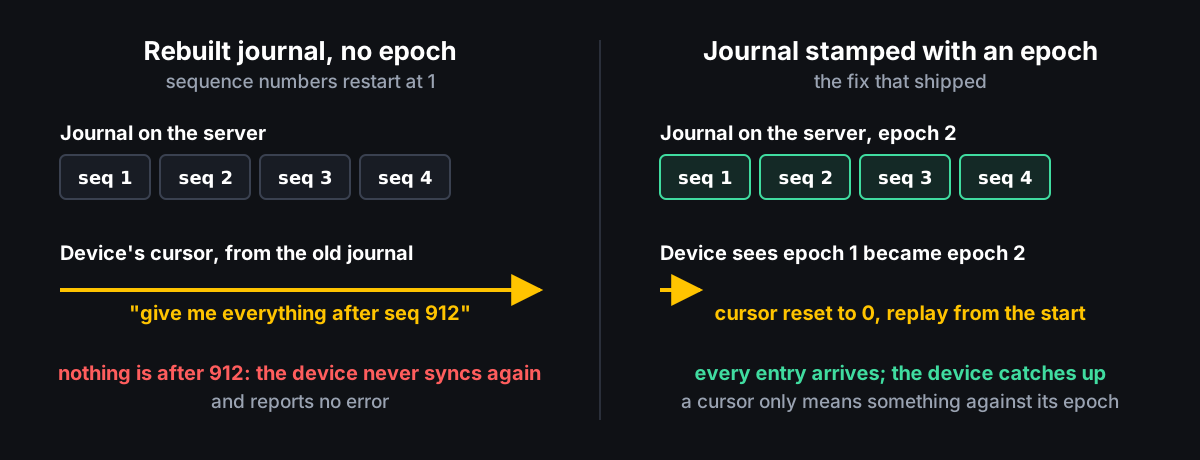
The journal now carries an epoch number, and a device that sees a new one replays from zero.
Last, identity (#20). The identity check was on cloudBackup and syncNow, but finishFlow called flushOutbox directly, so finishing a workout as the other lifter on a shared phone posted it to the signed-in lifter’s journal, got a valid acknowledgement, and emptied the outbox. In an append-only log that is permanent. The fix moved the check to the one door every write passes through, and #21 stopped an unreliable /api/me call (a two-second timeout that a cold mobile network blows routinely) from being read as “no identity, allow everything”: the app now remembers the last identity it actually resolved and falls back to that.
Those four failure modes are what got extracted as durable-sync:
- a successful-looking response is not evidence that the write landed;
- a cursor only means something against the epoch it came from;
- pulling remote changes is not always safe;
- the identity check must be the only door.
Rampset now uses the package; its own 329-line copy of the journal was deleted (#22), and the class name and SQL schema were kept identical so the live Durable Object carried over without a migration.
Tests
 Test Files  34 passed (34)
      Tests  256 passed (256)
   Duration  5.22s
The engines are pure functions in src/lib/ and each has a test file beside it: progression, deloads, Madcow, plates, estimated one-rep max (one case pins five reps at 115 kg to an estimate of 133.3 kg, a value taken from the real export), the sync journal, backup round-trips, and the Sheet component whose browser-history handling was the root cause of a finish-flow bug in #11 (router.replace overwrote the history entry the sheet had pushed, so consuming it on close walked the user back into a fresh workout). The count was 240 at the initial release and has moved with the incident fixes and the importer deletion; 256 is what runs today.
Run your own
git clone https://github.com/isaacrowntree/rampset
cd rampset
npm install
cp .env.example .env.local     # your lifters, units, starting weights
npm run dev                    # → http://localhost:3000
npm test                       # vitest — the engines, store, sync, components
npm run deploy builds with the OpenNext adapter (which packages a Next.js app for Cloudflare) and ships to Cloudflare Workers; wrangler.jsonc declares the SYNC_JOURNAL Durable Object (a new_sqlite_classes migration) and the BACKUPS R2 bucket. Put a Cloudflare Access application in front of the Worker and allow your lifters’ emails. Workers and Access are free for a household. The one paid gate is R2: the data sits well inside the 10 GB free tier, but Cloudflare wants a card on file to enable it. Without it, drop the BACKUPS binding; the app works fully offline on the local IndexedDB store, and the Export button in Settings hands you a complete CSV whenever you want.
What I would tell the subscription app
The migration cost me a Saturday and the incident cost me a week, and the week was the useful part. Every bug in it returned a 200. A loyal customer with an export file is no longer locked in by anything, and with a coding agent in the loop “I’ll build it myself” is a weekend, not a threat. The two proven programs, the plate math and the sync are all in a public repo under a licence that says make it yours. Take it somewhere no subscription can reach you.